
Arm Lift in Ohio
Excess skin on the upper arms can cause physical discomfort and obscure your natural arm contours. An arm lift removes excess, inelastic tissue to restore balanced contours, reduce skin friction, and improve everyday comfort.
What Is an Arm Lift?
Clinically known as brachioplasty, an arm lift is a surgical procedure that removes excess, overstretched skin and localized fat from the upper arms. This procedure is commonly performed after significant weight loss or as part of the natural aging process. By addressing heavy or sagging tissue, an arm lift relieves chronic chafing, improves daily comfort, and helps clothing fit more easily.
Proportionate
Contours
Reshapes the upper arms to balance your natural silhouette

Enhanced
Comfort
Relieves chronic skin chafing and irritation under the arms
Firmer
Appearance
Removes excess, inelastic skin that does not improve with exercise
Is an Arm Lift
Right for Me?
An arm lift balances meaningful contour improvement with the trade-off of a permanent scar, making careful patient selection an important part of treatment planning.
Good Candidates for an Arm Lift
- You have noticeable, inelastic skin on the upper arms.
- You maintained a stable weight near your goal.
- You understand and accept a permanent scar along the inner arm.
- You are committed to a nicotine-free recovery.
How It Works
Performed under general anesthesia, an arm lift requires careful surgical planning to safely remove excess tissue while protecting important nerves and blood vessels.
01
Incision Placement
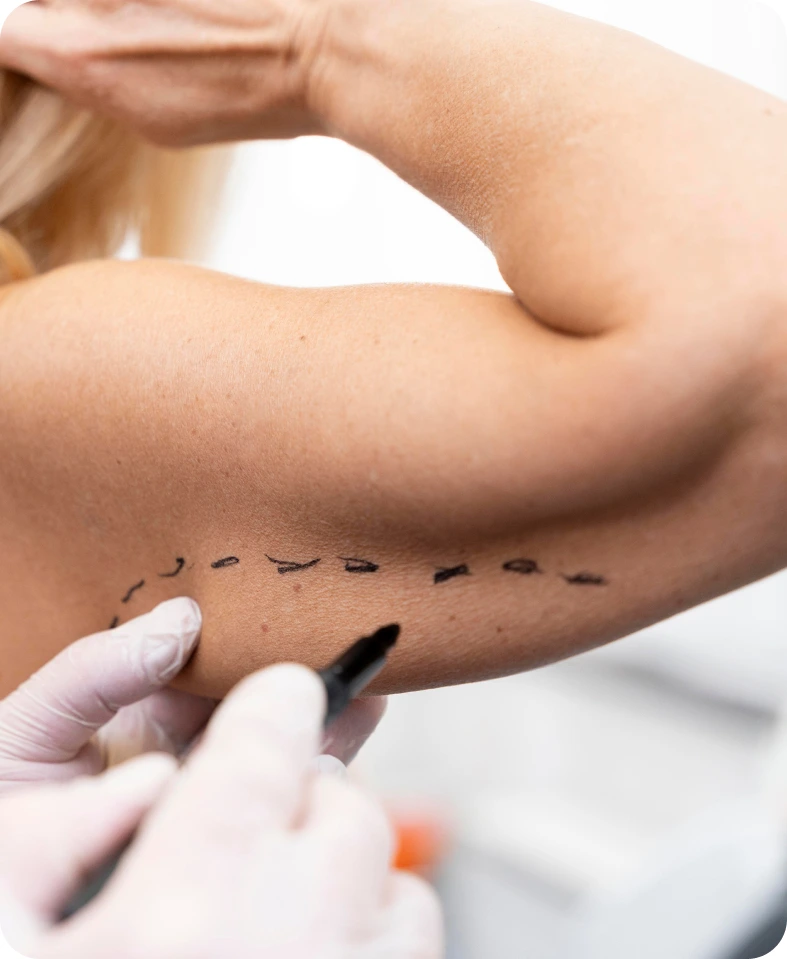
Your surgeon creates a longitudinal incision, typically extending from the armpit down toward the elbow, positioned along the inner or back of the arm to minimize visibility.
02
Tissue Resection
Excess skin and localized fat are carefully excised. Your surgeon distributes tension across the incision to support healthy healing.
03
Nerve Preservation
The surgical team meticulously navigates around the neurovascular structures while protecting the nerves that help provide sensation to the forearm and surrounding tissues.
04
Layered Closure
The incision is closed with internal, tension-relieving sutures to support healing while minimizing tension across the incision.
Types of Arm Lift
Your anatomy and the amount of excess skin help determine the most appropriate surgical approach. Your surgeon will recommend the technique that maximizes contour improvement while managing visible scarring.
Mini Arm Lift
(Axillary Brachioplasty)
How it works: Uses a small, discreet incision typically hidden within the natural crease of your armpit to remove minor amounts of skin and fat
Best for: Patients with mild sagging located just near the underarm area
Standard Arm Lift
(Traditional Brachioplasty)
How it works: Creates an incision along the inner or back of the arm, from the armpit down to the elbow, allowing your surgeon to remove larger areas of excess skin
Best for: Patients with noticeable, hanging skin along the full length of the upper arm
Extended Arm Lift
(Extended Brachioplasty)
How it works: Carries the standard incision past the armpit and slightly down the side of the chest to remove excess skin extending from the upper arms into the side of the chest for a smoother upper-body contour
Best for: Patients who have experienced significant weight loss and have excess skin extending from the arms into the upper body
Recovery Timeline
Weeks 1-2
Swelling and discomfort are expected. Keeping your arms elevated helps manage swelling. You will wear a compression garment 24/7. Reaching overhead or lifting is strictly restricted.
Weeks 3–4
Bruising continues to improve. If drains were placed, they are typically removed during this stage. You may return to light daily activities and non-strenuous work, but lifting restrictions remain.
Weeks 6–8
Incisions continue to heal. With your surgeon’s clearance, you can gradually resume moderate exercise and increase your range of motion.
Months 6–12+
Swelling continues to improve as your scar gradually softens and becomes less noticeable over time.
Frequently Asked Questions
Will my scars be visible?
The central trade-off of an arm lift is a permanent scar. The incision typically runs from the armpit to the elbow on the inner or back surface of the arm. While the scar is permanent, your surgeon uses meticulous closure techniques and provides long-term silicone scar management protocols to help it fade as much as possible over 12 to 18 months.
Can liposuction alone fix my arms?
If your primary issue is excess fat and you have excellent skin elasticity, liposuction alone may be sufficient. However, if you have overstretched, pendulous skin—common after massive weight loss—liposuction may remove volume without addressing the excess skin, worsening the sagging appearance. In these cases, surgical skin excision is required.
How long before I can lift heavy objects again?
Most patients avoid heavy lifting and overhead activities for several weeks to protect the incision while it heals. Your surgeon will let you know when it’s safe to gradually resume these activities
Will I lose feeling in my arm after surgery?
Temporary numbness or changes in sensation around the incision are common during early healing. Sensation often improves over time as the tissues recover.
*This page is for educational purposes only and is not a substitute for a consultation with a board-certified surgeon. Every patient is unique, and treatment recommendations and results vary. We encourage you to schedule a consultation with our team to discuss your options.
Schedule a Consultation
If you’re considering an arm lift, we’re here to help you move forward with confidence. Schedule a consultation to discuss your goals and create a personalized treatment plan.