
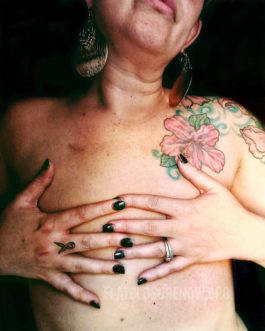
In our practice, we see an increasing number of patients who have undergone prior mastectomy and have chosen to forgo any breast reconstruction procedures. Unfortunately, these patients are oftentimes left with excess skin and soft-tissue at the inframammary fold area – the lateral trunk area – and sometimes overhanging their mastectomy incision. Many of these patients have been quite clear and explicit in their desire not to undergo reconstructive surgery.
Tragically, some of these patients nonetheless were left with excess skin to allow for potential future reconstruction. This type of flat denial medical course is one that we, as surgeons, must re-evaluate.
Flat Result Techniques
One of the primary concerns for patients is that their wishes to remain flat after mastectomy be respected. From a surgeon’s perspective, achieving an aesthetic and normal contoured flat result can be quite difficult. Many breast surgeons, who are general surgeons by training, may not be familiar with certain plastic surgery techniques such as standing cone deformity excision, local transposition flaps, and fat grafting to address contour deformity areas, Pectus excavatum, and asymmetries of the chest wall. As such, achieving a truly flat result can be a difficult outcome to achieve.
In our practice, we have developed a process for effective communication with our breast surgeons to address patients’ concerns who desire to remain flat. We have a combined approach to achieve this desired result. In developing such a program, we have realized that many patients would like to proceed with a “one-and-done” type result after mastectomy to achieve a flat result.
Realigning with Patient Expectations
In my opinion and our experience, I believe that we, as surgeons, must work to realign patient expectations. I think that promising a single-stage aesthetic flat result is, more often than not, an unreasonable level of expectation to set for patients.
I meet with many patients who have expressed a desire to be flat after mastectomy. These meetings can be before mastectomy surgery or after they have healed from a mastectomy. During this conversation, we discuss the specific issues that I will foresee for them.
As a reconstructive plastic surgeon and microsurgeon, I must take into account variables such as:
- Body mass index
- Native breast volume
- Soft tissue properties
- Breast size
- Tumor location
- Need for radiation treatment
In our practice, we are oftentimes successful with insurance coverage for these types of reconstructive procedures under the auspices of the Women’s Healthcare Act of 1998.
Allowing a Consistent Result
It is important to understand that addressing the patient’s anatomical constraints and explaining what they will expect after a mastectomy is critically important to set the appropriate expectation level.
In our practice, the optimal time to achieving an aesthetic, flat result is approximately three months after mastectomy. This time frame allows for adequate healing and soft tissue softening to achieve a truly flat result.
Plastic surgery techniques such as total en-bloc capsulectomy, implant removal, excision of standing cone deformity, local transposition flaps, and fat grafting are tools in the plastic surgery toolbox to allow for a consistent result.
High-quality Outcomes for Patients
For many patients achieving an aesthetic flat result allows a significant measure of control over the decision-making process, allows for patient empowerment, and allows wearing an external prosthesis appropriately if they so choose. The surgical community has much work to do to improve surgeon education and patient communication on this important topic.
Plastic surgery is a science built on delivering results that meet the patient’s expectations, and we must be careful to avoid a one-size-fits-all approach.
As the flat closure community continues to develop, there is a great opportunity to develop approaches that safely deliver high-quality outcomes to our patients.